

Which C/O Form is used for exports within ASEAN?
What is C/O Form D?
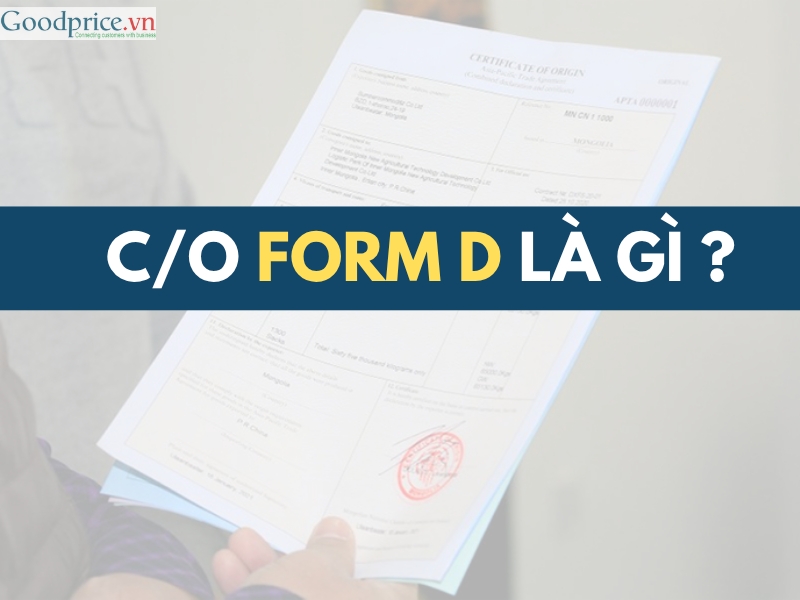
C/O Form D (Certificate of Origin – Form D) is a Certificate of Origin used within the ASEAN region, issued for goods originating from ASEAN member countries under the ASEAN Trade in Goods Agreement (ATIGA).
When Vietnamese enterprises export goods to ASEAN countries such as Thailand, Malaysia, Indonesia, the Philippines, etc., those goods will be eligible for preferential import duty (usually 0%) under intra-ASEAN commitments if accompanied by a valid C/O Form D.
In simple terms, C/O Form D is the “key” that helps Vietnamese goods easily access ASEAN markets at lower costs.
Purpose of Issuing C/O Form D
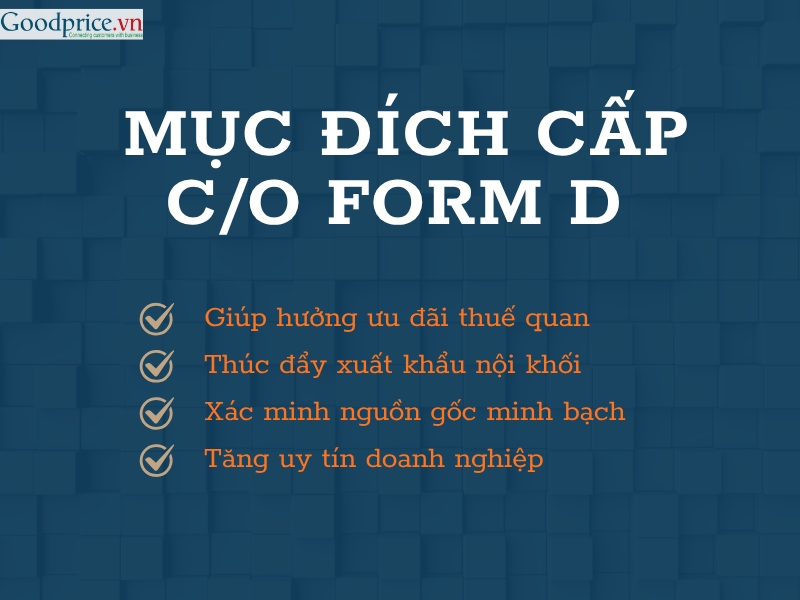
The issuance of C/O Form D is not merely a formality but carries significant economic and trade importance:
- To enjoy preferential tariff treatment: When goods are accompanied by C/O Form D, the importer in an ASEAN member state will be entitled to reduced or exempted import duties under preferential rates in ATIGA.
- To promote intra-ASEAN exports: This policy enhances the competitiveness of ASEAN goods compared to imports from outside the region.
- To ensure transparent origin verification: C/O Form D certifies that the goods are truly produced or processed within the ASEAN region, preventing trade fraud.
- To strengthen enterprise credibility: Possessing a properly issued C/O demonstrates that the exporter is professional and compliant with international trade standards.
Watch now: TikTok video – Which C/O Form is used for exports within ASEAN?
Conditions for Issuance of C/O Form D

To qualify for a C/O Form D, the goods must meet the rules of origin (ROO) under ATIGA. Specifically:
- Goods must have ASEAN origin – achieving at least 40% ASEAN content (RVC ≥ 40%), or meeting the Change in Tariff Classification (CTC) criterion as stipulated.
- Imported materials from non-ASEAN countries must not exceed 60% of the FOB value of the goods.
- The manufacturing process must take place in one or more ASEAN member states.
- Goods must be shipped directly from the exporting country to the importing country (transshipment is allowed provided that no further processing occurs).
- Cumulation principle: If production involves more than one ASEAN country, the ASEAN content from each country can be accumulated to determine origin.
Example: Vietnam produces slippers from rubber imported from Malaysia → the product still qualifies for C/O Form D, as the material originates from within ASEAN.
Documents Required for Applying for C/O Form D
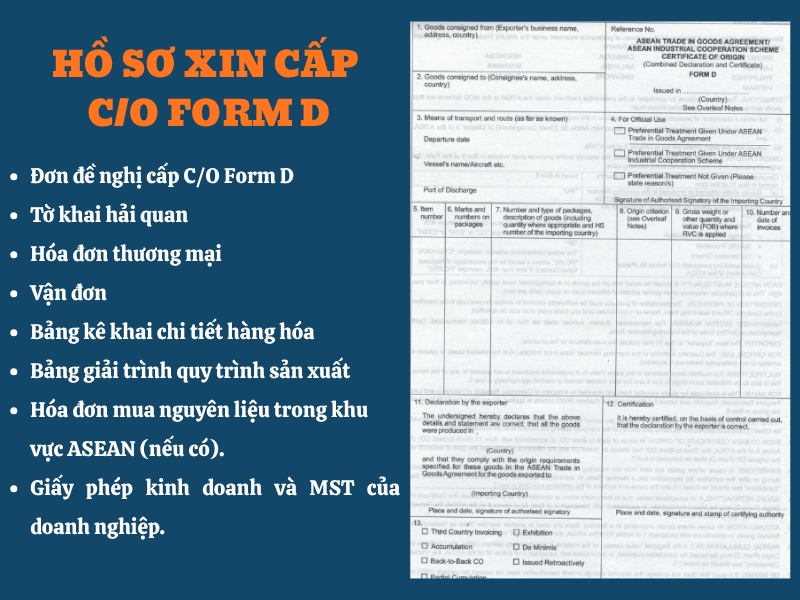
When submitting an application for C/O Form D (paper-based or electronic), enterprises must prepare the following documents:
1.Application form for C/O Form D (as prescribed in Circular No. 10/2022/TT-BCT).
2.Export customs declaration already completed.
3.Commercial Invoice.
4.Bill of Lading or equivalent transport document.
5.Packing List.
6.Production process explanation showing the ASEAN value content (≥ 40%).
7.Invoices of materials purchased within ASEAN (if any).
8.Business registration certificate and tax code of the exporter.
Currently, enterprises can submit applications online via the ECOSys system of the Ministry of Industry and Trade, saving time and enabling progress tracking conveniently.
Cases of Rejection of C/O Form D Application
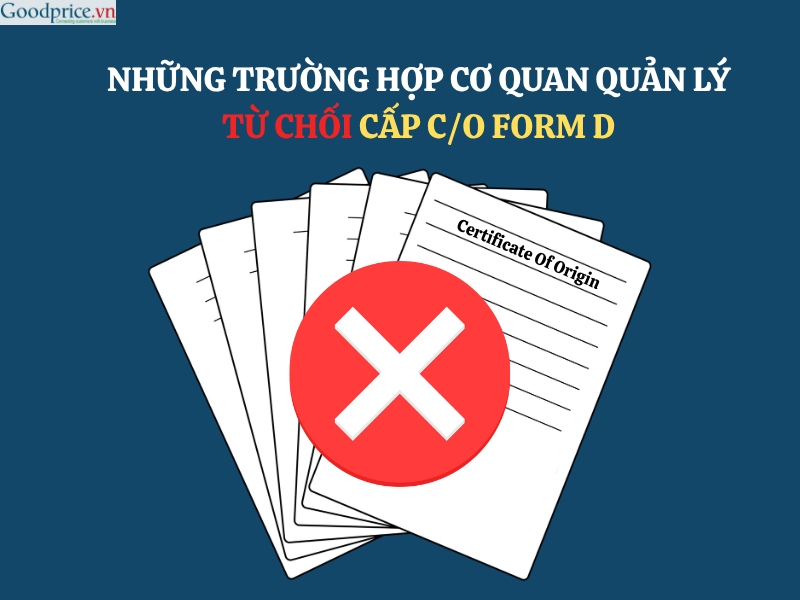
Enterprises may be denied issuance of C/O Form D in the following cases:
- Goods do not meet origin criteria (ASEAN content < 40%, or too much non-ASEAN material used).
- Incorrect or incomplete documentation (missing invoice, RVC calculation sheet, or incorrect exporter details).
- False declaration of origin, detected during verification.
- Failure to prove that the production process took place within ASEAN.
- C/O issued in the wrong format, or lacking official signature or seal of the issuing authority.
- Late submission beyond the permitted timeframe without valid justification (for cases of retroactive issuance).
If rejected, the enterprise will receive a written notification specifying the reasons, allowing for correction and resubmission. However, in serious violations (such as forged documents), the enterprise may face temporary suspension of its right to apply for C/O.
Read more: Why is fumigation of wooden pallets required in export shipments?
Conclusion
When exporting goods within the ASEAN bloc, Vietnamese enterprises must use C/O Form D to enjoy preferential import duties. Understanding its purpose, eligibility conditions, application process, and potential risks will help exporters save time, reduce costs, and minimize the likelihood of rejection.
GOODPRICE VIETNAM CO.,LTD
Email: [email protected]
Facebook: Goodprice Viet Nam
Phone: 0906368199 - 0916112833
Hotline: 1900636299
The article is of interest.

What Are the Health Benefits of Moringa for Modern Lifestyles

Tổng hợp công dụng của cải kale – Thực phẩm siêu dinh dưỡng

Discover the Benefits Of Lotus Root Powder
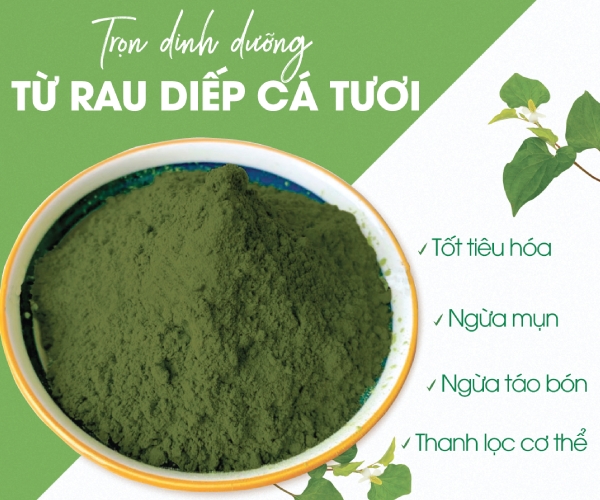
Bột diếp cá sấy công nghệ cao giàu dưỡng chất

GOODPRICE CELERY POWDER – THE OPTIMAL INGREDIENT SOLUTION FOR BUSINESSES