

Which C/O Form Should Be Applied for Goods Exported to Japan?
Which C/O Form Should Be Applied for Goods Exported to Japan?
In export activities, the Certificate of Origin (C/O) is one of the most important documents, helping goods enjoy preferential tariff treatment when imported into foreign markets.
Especially when exporting to Japan – one of the most demanding but potential markets for Vietnam – determining the appropriate C/O Form is even more crucial.So, which C/O Form should Vietnamese exporters choose when exporting to Japan to enjoy the highest tariff preferences? Let’s explore in detail below.
Overview of Common C/O Forms for Exports to Japan
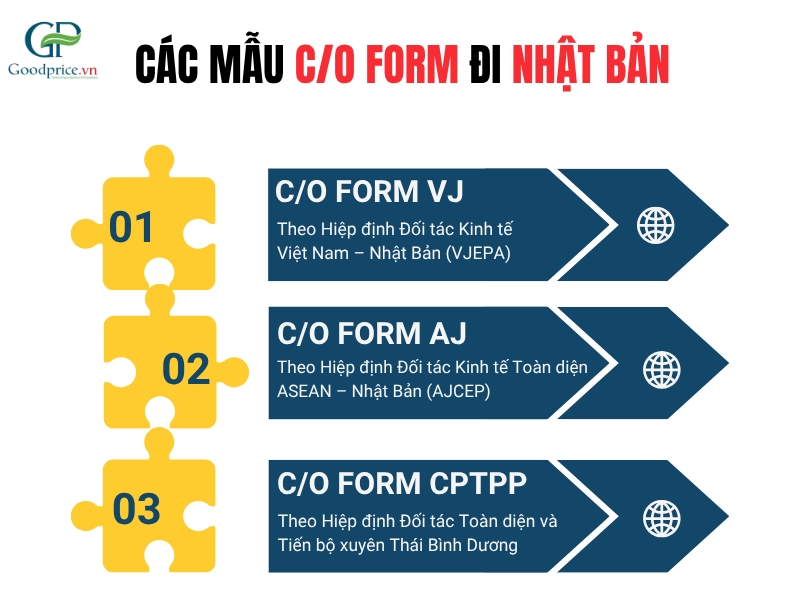
1.C/O Form VJ – Under the Vietnam–Japan Economic Partnership Agreement (VJEPA)
This C/O Form is applied exclusively between Vietnam and Japan, based on the VJEPA Agreement signed in 2008.
- Scope of application: Goods wholly obtained or with sufficient local value content from Vietnam, exported directly to Japan.
- Advantages: Enjoys preferential import tariffs under Japan’s specific commitments to Vietnam, with many goods having tariffs reduced to 0%.
- Characteristics: C/O Form VJ is issued by the Ministry of Industry and Trade of Vietnam (or an authorized agency). The application can be submitted before, during, or after export, provided that the goods meet the rules of origin.
- Best suited for: Enterprises producing mainly in Vietnam such as agricultural products, processed food, handicrafts, and natural materials.
2.C/O Form AJ – Under the ASEAN–Japan Comprehensive Economic Partnership (AJCEP)
C/O Form AJ applies to goods exported from Vietnam or other ASEAN countries to Japan.
The AJCEP Agreement facilitates preferential import tariffs for goods originating from the ASEAN region when entering Japan.
- Scope of application: Goods originating or manufactured in Vietnam or other ASEAN member countries.
- Advantages: Broader coverage compared to Form VJ since it allows cumulation of origin within ASEAN (for example: raw materials from Thailand, assembled in Vietnam, still qualify as originating goods).
- Characteristics: Form AJ is issued under Circular No. 37/2022/TT-BCT, with a fixed format in English, including required fields such as: product description, HS code, origin criterion, invoice reference, means of transport, and certification by the issuing authority.
- Best suited for: Enterprises with supply chains within ASEAN–Japan, such as electronics, textiles, and processed agricultural goods.
3.C/O Form CPTPP – Under the Comprehensive and Progressive Agreement for Trans-Pacific Partnership
The CPTPP Agreement is a new-generation FTA with deeper market access and higher tariff preferences.
Both Vietnam and Japan are CPTPP members; therefore, goods exported between the two countries can apply for C/O Form CPTPP.
- Scope of application: Goods originating from Vietnam or other CPTPP member countries.
- Advantages: Offers deeper tariff reduction than VJEPA and AJCEP. Exporters are allowed to self-certify origin, without requiring a C/O from the authority, if approved by the Ministry of Industry and Trade.
- Characteristics: The CPTPP C/O has no fixed format, but must include all required information (HS code, product description, origin criterion, exporter, importer, signature, etc.).
- Best suited for: Exporters with large-scale operations, strong documentation control, wishing to shorten clearance time and benefit from the lowest tariff rates.
>>> Quick view: Typical cases when applying for C/O for goods exported to Japan
Which C/O Form Should Enterprises Apply for Exports to Japan?
In practice, all three C/O Forms (VJ, AJ, CPTPP) are valid in Japan.
However, to select the most beneficial Form, exporters must consider product origin, rules of origin, and Japan’s preferential tariff schedule under each FTA.
- If goods are wholly produced in Vietnam and exported directly to Japan → Form VJ is the traditional and most straightforward option.
- If goods contain materials or production stages from ASEAN countries → Form AJ is preferable to benefit from origin cumulation.
- If goods meet CPTPP origin criteria or exporters wish to self-certify origin → Form CPTPP is the most flexible and modern choice.
Each FTA has its own preferential tariff schedule. Therefore, before applying, enterprises should check Japan’s Customs Tariff Schedules to determine which Form offers the lowest applicable tariff for their specific product.
Required Conditions to Apply for C/O for Exports to Japan
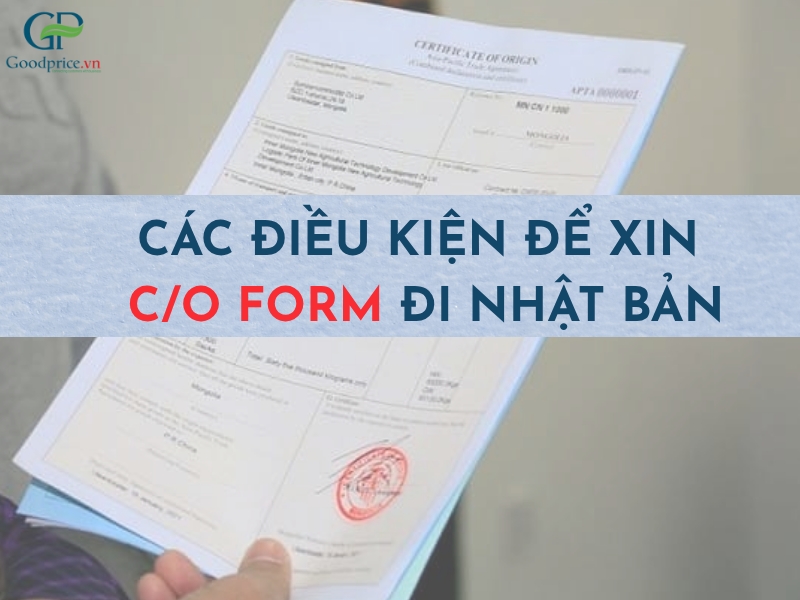
Regardless of whether it is VJ, AJ, or CPTPP, a C/O will only be issued when the goods fully meet rules of origin and documentary requirements.
A valid C/O application dossier must ensure:
- Goods with clear origin:
+ Must satisfy the origin criteria (WO – Wholly Obtained, PE – Produced Entirely, RVC – Regional Value Content, CTC – Change in Tariff Classification, etc.).
+ Must include supporting documents proving material origin and production process.
- Transparent and complete documents:
+ Customs declaration, commercial invoice, bill of lading, material list, production process, regional value calculation sheet, etc.
+ For imported materials, valid origin documents must be provided.
- Consistency across documents:
+ Product name, quantity, HS code, origin, shipment date, etc., must match exactly.
+ Any minor inconsistency may result in rejection of the C/O application.
- Exporter registration:
+ The exporter must have registered company profile, signature, and seal samples at the issuing authority (or registered for self-certification under CPTPP).
- Proper submission process:
+ File an electronic declaration via the Ecosys system
+Then submit hard copies for verification and approval.
>>> See more: Which C/O Form is used for exports within the ASEAN region?
Conclusion
Japan is one of Vietnam’s top three export markets, with strong demand for agricultural products, processed foods, wooden goods, consumer items, and bio-based materials. Applying for the right C/O Form not only helps goods enjoy preferential import tariffs but also shortens customs clearance time, enhances credibility, and improves competitiveness in the Japanese market. Therefore, exporters should always evaluate all three Forms before each shipment, choosing the FTA that offers the highest tariff benefit and easiest procedure.
GOODPRICE VIETNAM CO., LTD
Email: [email protected]
Facebook: Goodprice Việt Nam
Phone: +84 906368199 / +84 916112833
Hotline: 1900636299
The article is of interest.
Versatile And Wonderful Uses Of Taro Powder
Tổng hợp công dụng của cải bó xôi dành cho sức khoẻ
Tác dụng của bột cần tây dành cho sức khỏe và giảm cân

WHERE TO BUY RELIABLE CORN POWDER? HOW TO CHOOSE HIGH-QUALITY CORN POWDER

Why Yellow Sweet Potato Powder Is Becoming a Trend in the Global Snack Industry